
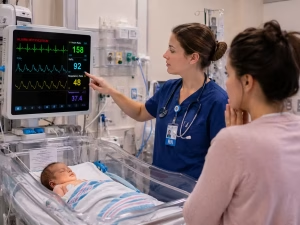
Seeing a hospital baby monitor for the first time can feel scary. If you want to know how to read baby monitor at hospital, start by looking at the main numbers for heart rate, oxygen level, breathing rate, and blood pressure. This is the quick answer most parents need.
I remember standing by a newborn’s bedside and watching the screen change every few seconds. The good news is that most hospital monitors in the U.S. follow a similar setup. As someone who has spent years researching newborn care and medical monitoring, I can tell you that understanding these readings is easier than it looks. In this guide, I’ll walk you through each number, alarm, and waveform so you can feel more informed and confident while your baby receives care.

How to Read a Baby Monitor at Hospital: Quick Answer
A hospital baby monitor shows how your baby is doing right now. It shows heart rate, oxygen level, breathing rate, blood pressure, and sometimes body temperature.
The screen can look scary at first. I felt the same way when I first saw all the numbers and lights. The good news is that most monitors work in a similar way. Once you know what each number means, the screen is much easier to read.
Purpose of a Hospital Baby Monitor
Why Newborns Are Continuously Monitored
A baby monitor helps staff watch your baby all day and night. It can spot changes fast.
Newborns can change quickly. The monitor works like an extra set of eyes. It helps nurses and doctors keep track of your baby’s health.
Differences Between Nursery, NICU, and Postpartum Monitoring
Not all babies need the same level of monitoring. The type of care depends on the baby’s needs.
A healthy baby in a postpartum room may need only basic checks. A baby in the NICU may have many sensors and a monitor that runs all the time.
What Information the Monitor Tracks
A baby monitor tracks key body signs. These signs help show how your baby is doing.
Most monitors show heart rate, oxygen level, and breathing rate. Some also show blood pressure and temperature.
Before Reading a Baby Monitor at Hospital

When Monitor Readings Are Useful
Monitor readings help when you look at trends. A trend shows what happens over time.
One number does not tell the full story. Doctors look at many readings and how the baby looks and acts.
Situations Where Readings Can Be Misleading
Monitor readings are not always perfect. A loose sensor can cause a wrong reading.
I have seen parents worry when a number drops for a few seconds. In many cases, the sensor moved and the baby was fine.
Understanding That Alarm Limits Vary by Baby
Each baby has different alarm limits. These limits are set by the care team.
A baby born early may have different goals than a full-term baby. That is why you should not compare one baby to another.
What Parents Should Know Before Interpreting Numbers
A monitor gives clues about a baby’s health. It does not give a diagnosis.
The best plan is to learn what the numbers mean. Then ask your nurse or doctor if you have concerns.
Heart Rate Interpretation: How to Read Baby Monitor at Hospital
What Heart Rate (HR) Means
Heart rate shows how fast the heart beats. It is often one of the largest numbers on the screen.
The monitor counts how many times the heart beats each minute. This helps staff check blood flow and heart function.
Typical Heart Rate Ranges for Newborns
Most newborns have a heart rate of 100 to 160 beats per minute. This range is normal for many healthy babies.
The number may change during sleep, feeding, or crying. Small changes are often normal.
Sleep vs Awake Heart Rate Differences
Heart rate is often lower during sleep. It is often higher when a baby is awake.
A baby who cries or moves may have a faster heart rate. This is a normal body response.
When High or Low Readings May Occur
Heart rate can change for many reasons. Some reasons are normal.
Sleep, feeding, crying, and movement can affect the number. Illness can also change heart rate.
Common Sensor-Related False Readings
Sensors do not always stay in place. When they move, the monitor may show the wrong number.
If a reading looks odd, staff often check the sensor first. A loose lead is a common cause.
Oxygen Saturation Reading: How to Read Baby Monitor at Hospital
What SpO₂ Measures
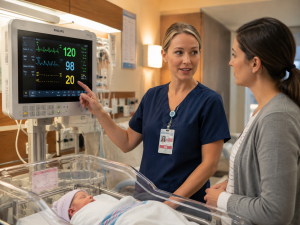
SpO₂ shows the amount of oxygen in the blood. It helps staff know if the body is getting enough oxygen.
A small sensor on the hand or foot checks this level. The test does not hurt.
Typical Oxygen Saturation Targets
Many healthy newborns have oxygen levels from 95% to 100%. This is a common target range.
Some babies need a different goal. The care team decides what range is best.
Why Premature Babies May Have Different Targets
Babies born early may need special oxygen goals. These goals help keep them safe.
Too much oxygen can be a problem for some babies. Too little oxygen can also cause harm.
How Pulse Oximeter Sensors Work
The sensor uses light to check oxygen levels. It does not use needles.
The light passes through the skin. The monitor then estimates the oxygen level.
Causes of Temporary Oxygen Drops
Short drops in oxygen levels can happen. Many are not serious.
A moving foot, a loose sensor, or feeding can affect the reading. A low reading that lasts needs medical review.
| SpO₂ Reading | What It May Mean |
|---|---|
| 95–100% | Common range for many healthy babies |
| Target Set by Care Team | Often used in the NICU |
| Low Reading That Stays Low | Needs medical review |
Oxygen level is one part of the picture. Doctors also look at how the baby looks, breathes, and acts.
FAQs for How to Read Baby Monitor at Hospital
What do the numbers mean on a hospital baby monitor?
The numbers show your baby’s heart rate, oxygen level, breathing rate, and other vital signs. These readings help staff track your baby’s health in real time.
How do I read a baby monitor at hospital correctly?
Start by finding the labels for each reading. Then check the numbers, look for trends, and ask staff if you are unsure what a value means.
What is a normal heart rate on a hospital baby monitor?
Most healthy newborns have a heart rate between 100 and 160 beats per minute. The number may rise or fall based on sleep, feeding, or movement.
Why does a hospital baby monitor alarm go off?
Many alarms happen because a sensor moves or comes loose. Some alarms may signal a change in your baby’s condition, so staff will check both the monitor and baby.
What is a normal oxygen level on a baby monitor?
Many healthy newborns have an oxygen level between 95% and 100%. Some babies, especially in the NICU, may have different target ranges.
Can a baby monitor give a false reading?
Yes. A loose sensor, baby movement, or poor signal can cause false readings. This is why nurses check the baby and not just the monitor.
Why does my baby’s monitor reading change so often?
Monitor readings can change with sleep, feeding, crying, or movement. Small changes are common and do not always mean there is a problem.
What should I do if I see an unusual reading on the monitor?
Stay calm and look for changes over time. If the reading stays unusual or concerns you, tell a nurse or doctor right away.
Do all hospital baby monitors show the same information?
Most monitors show heart rate, oxygen level, and breathing rate. Some also display blood pressure, temperature, and trend data.
Should parents rely on a hospital baby monitor alone?
No. A monitor is a helpful tool, but it does not replace medical care. Doctors and nurses use monitor data along with a full clinical assessment.

Shahin is the owner and creator of BabyCareAdvisor, a trusted resource for practical baby care and parenting guidance. He shares helpful, easy-to-understand information about baby products, car seats, strollers, breast pumps, baby safety, and everyday parenting. His goal is to help parents make informed decisions by providing clear, practical, and research-based advice.